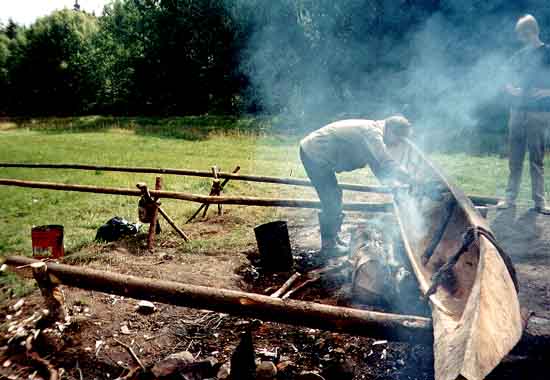
Hollowed bottom part is placed onto especially made structures like sawhorses over fire, so it can be easily moved and heeled for heating any desirable spot directly in the flame. Its inner surface must be kept wet with hot water water and steam, so it would soften and the inner layers would swell.
Expanding technique for pine wood was not known; plenty of experiments in smaller scale were done before it was found anew. Steaming alone does not soften pine wood enough to achieve the necessary expanding rate without cracks; two other factors were helpful:
- When wood is getting charred and starts to burn in a fire, it shrinks; that is why a stick of firewood would cover with a grid of small cracks. So, if the outer surface of a piece to be expanded is charred, the piece would turn outwards.
- High gradient of humidity can be created over the wall’s thickness by keeping its inner side wet with hot water, and heating its outer side dry over fire. Then inner layers would swell with water and steam, while outer ones are dry and shrunk; this would also cause a strong effect, turning the piece outwards. This factor is probably the strongest with this technique, though temporary: the humidity gradient disappears as soon as expanding procedure was finished. Serious measures have to be taken to prevent a freshly expanded piece from quick drying — it would crack then; a little water can be poured inside it, and some cover from direct sun provided.
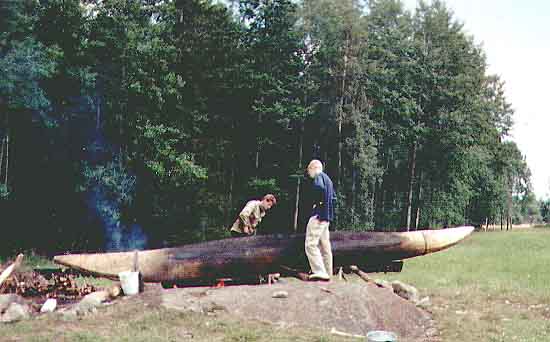
Outer surface of the bottom piece has to be kept over fire until it gets dry and starts to smoke and char; at this moment outer layers of wood shrink quite a lot.
All these factors are combined easily and naturally within this technique, and the site of a piece getting completely flat from initial diameter of 30cm without applying any external force is exciting enough. Bottom piece was expanded from 45 to some 120 cm diameter, becoming 100cm wide, while initially its edges were only 20cm apart. Sometimes one can see a firewood stick or some chip twisting and bending quite a lot in fire — this is basically the same effect, just under conscious control. Expanding technique for aspen dugouts described in literature, does not seem to differ much from this one, too; at least heating with fire is always done from outside, and humidity gradient must exist anyway. Also, the outer surface always get more or less charred.
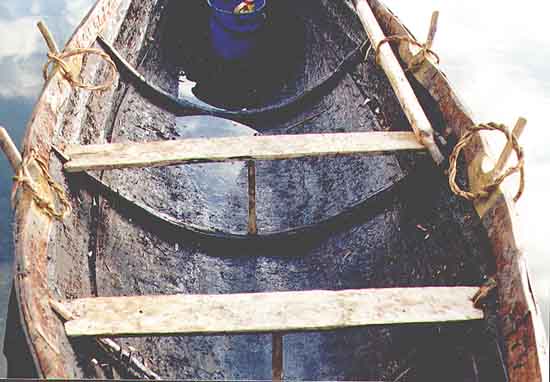
Inside view of the boat. Shape of the expanded bottom part is clearly visible.
For drawbacks and bottlenecks of this technique several things are to be mentioned:
- When expanding procedure seems to be finished successfully, it is yet too early to celebrate, in fact, now the most dangerous time is coming. The humidity gradient will disappear, and wood will tend to recover its initial round crossection (at least to a certain extent). As spreading bars or clamps now prevent it from doing so, it will acquire wave-like crossection shape, thicker and stronger belts turning inward, causing thinner and weaker ones to turn still more outward. This is along these weaker belts that cracks will appear, making them even weaker, and, therefore, causing their further turning outwards, and so on — sort of an avalanche-like process. The result is clearly visible on the picture of ready planks drying. Freshly expanded piece feels very tense, it must be immediately covered with boiling tar, this makes wood more elastic and makes its drying more slow and even. The piece must be fixed into its final shape with all kinds of spreading bars, clamps and wedges, to keep weaker belts from bulging in, and stronger belts from bulging out, i.e. to keep the curvature as even as possible. Plank pieces were fixed flat by means of sticks on both sides, tightly tied together.
- Thickness and humidity of a piece are never perfectly even, so some spots will get dry and start burning over the fire sooner, and other spots later. As thinner and dryer ones burn on the surface, they become still thinner and dryer with respect to the rest of the piece — another avalanche-like process, which might result into burnt-through holes, let alone thin weak zones and belts. So one have to watch the outer surface constantly during the expanding, wet the thinner spots with water from outside, too, or even apply wet rugs to them; sometimes they must be covered from direct flame by a piece of plank or a big chip.
Generally, the expanding procedure is the hardest and most stressful stage with this boat. It has to be taken quite seriously, everything must be prepared beforehand, till the smallest firewood stick; even then the bottom expanding took more then seven hours without breaks. It would make sense to have a team of 2-3 people for this job, for instance, the Finnish aspering bottom was said to be expanded in 3 hours by 3 men, by the way, one of them had the only duty to watch the outer surface and keep thinner spots from burning too much.
Source: Mika Naimark, https://sewboat.narod.ru/tunaboat/exp.html

